

RIC Disaster Management
Case Study Town of Canmore
RIC Disaster Management
Case Study
Town of Canmore
Case Study Interviewee
Eleanor Miclette has served as the Manager of Economic Development for more than eight years. Alongside her team of 10, she helps businesses at every stage—from startup and growth to navigating unexpected disruptions.
With a strong focus on economic resilience, Eleanor works to grow the capacity of Canmore businesses through training, workshops, and partnerships that help businesses better prepare for emergencies and recover quicker when disruptions occur.

Eleanor Miclette, Manager of Economic Development, Town of Canmore
Key Outcomes
-
100% of participants reported increased confidence in knowing which actions to take first during a crisis
-
100% reported feeling more prepared to protect staff, customers, operations, and reputation
-
86% reported improved confidence identifying key crisis role

Planning for Business Viability in a Region That is No Stranger to Disruption
The Town of Canmore (TOC), located in the Canadian Rockies’ Bow Valley, is always aware of the possibility of disasters and crises. Having seen what happened during the region’s 2013 floods, as well as other disasters in Alberta, including the Fort McMurray and Jasper fires, Economic Development Manager Eleanor Miclette knew how important crisis preparedness was to local businesses.
A Local Partner That Can Train Businesses to Plan for Crises
The Town of Canmore had previous experience working with RIC Disaster Management and had seen the company’s work with other municipalities. When RIC launched the Disaster to Dynamo workshop, which is part of its Bounce Back Biz program, Eleanor found it to be the perfect training to run for local businesses during Emergency Preparedness Week. The workshop is designed for small and medium-sized businesses to help them build a clear, usable plan for real-world disruptions without jargon, bureaucracy, or overwhelm.
Greater Confidence and a Clear Plan for When Disaster Strikes
As part of the Disaster to Dynamo workshop, participants learned how to identify critical business functions, assign emergency roles and responsibilities, identify stakeholders that need to be informed, and more. Businesses left with confidence and tangible plans and tools they could continue developing with their teams.
“Preparedness allows businesses to be more agile, and in the long run, we’ve seen the recovery to be faster, more targeted, and cost-saving.”
Supporting and Strengthening Canmore Businesses
The breathtaking mountain landscape surrounding the Town of Canmore attracts millions of visitors each year. However, it also exposes the community to natural hazards like wildfires, flooding, drought, and severe smoke events.
The town’s location—connected to neighbouring communities by a single major highway—can further complicate emergency response and evacuation during major incidents. But natural hazards aren’t the only threats local businesses face. Water outages, utility failures, security breaches, supply chain disruptions, and other unexpected events can all interrupt operations and put businesses at risk. This means preparedness isn’t just optional; it’s fundamental.
The Town of Canmore is home to more than 2,900 registered businesses in diverse sectors spanning tourism, hospitality, recreation, construction, manufacturing, healthcare and professional services. For the municipality’s leadership, including Economic Development Manager Eleanor Miclette, the goal of helping businesses prepare for disruption has become an essential part of protecting Canmore’s economy and ensuring the community can recover quickly after a crisis.

Building Economic Resilience in a High-risk Landscape
Eleanor has seen firsthand how preparedness influences recovery. In her 17-year career in economic development, she’s worked on the recovery efforts of the 2013 Alberta floods, the Fort McMurray wildfire, and the Jasper wildfire.
Through that work, Eleanor has seen drastically different scenarios play out. Some businesses were able to survive and adapt after disruptions because they had a plan. Others struggled to stay afloat because they hadn’t prepared.
“According to FEMA (Federal Emergency Management Agency) and SBA (Small Business Administration), up to 40% of businesses never reopen after a major disaster,” says Eleanor. “Additionally, 25%+ of those who do fail within one or two years. If operations can’t resume within five days, failure rates spike to 90% within one year. Those are staggering numbers that show why emergency preparedness is critical.”
Canmore faces ongoing risks from wildfires, flooding, smoke events and other catastrophic events. With this in mind, Eleanor knew the town’s local businesses needed training to be better prepared for disruptions.

“Think of it like first aid,” she says. “You never need first aid training until you need it, then you’re happy you have that knowledge. You never really know how deep that knowledge is until you are supporting someone with a life-altering response.”
Building this kind of preparedness across the business community is not an easy task, though. Eleanor has noticed the businesses that need the work the most often don’t engage in preparedness initiatives.
“By hosting workshops, our goal is to always get new people around the table to understand what they have already developed and how we can support them in strengthening that information,” she says.
Workshops With a Partner Who Understands the Region
The Town of Canmore decided to partner with local business owner Rebecca Innes of RIC Disaster Management to deliver RIC’s Disaster to Dynamo workshop to businesses in the community during Emergency Preparedness Week. The workshop is part of RIC’s Bounce Back Biz program for small and medium-sized businesses. Local businesses were invited to participate free of cost by the Town of Canmore.
RIC approached the engagement as a partnership, taking the time to understand community needs before the event and following up afterward with detailed reporting and recommendations.
“I love working with Rebecca because she gives me follow-up reports, which a lot of consultants don’t do,” says Eleanor.
RIC’s approach to the workshop was unique. Rather than overwhelming participants with technical emergency management information and jargon, the training focused on practical actions that small business owners could apply immediately.
Participants followed a step-by-step workbook that walked them through:
- Identifying critical business functions and leaders
- Identifying key stakeholders that need to be informed
- Assigning emergency roles and responsibilities for crisis leadership
- Preparing communication templates or placeholder text to use during disruptions
- Documenting response procedures
Participating businesses left with tangible planning tools they could continue developing with their teams.
And the learning didn’t stop at the workshop. After the session, RIC analyzed participant feedback, followed up with individual businesses, and created a report identifying opportunities to build additional resilience across the business community.
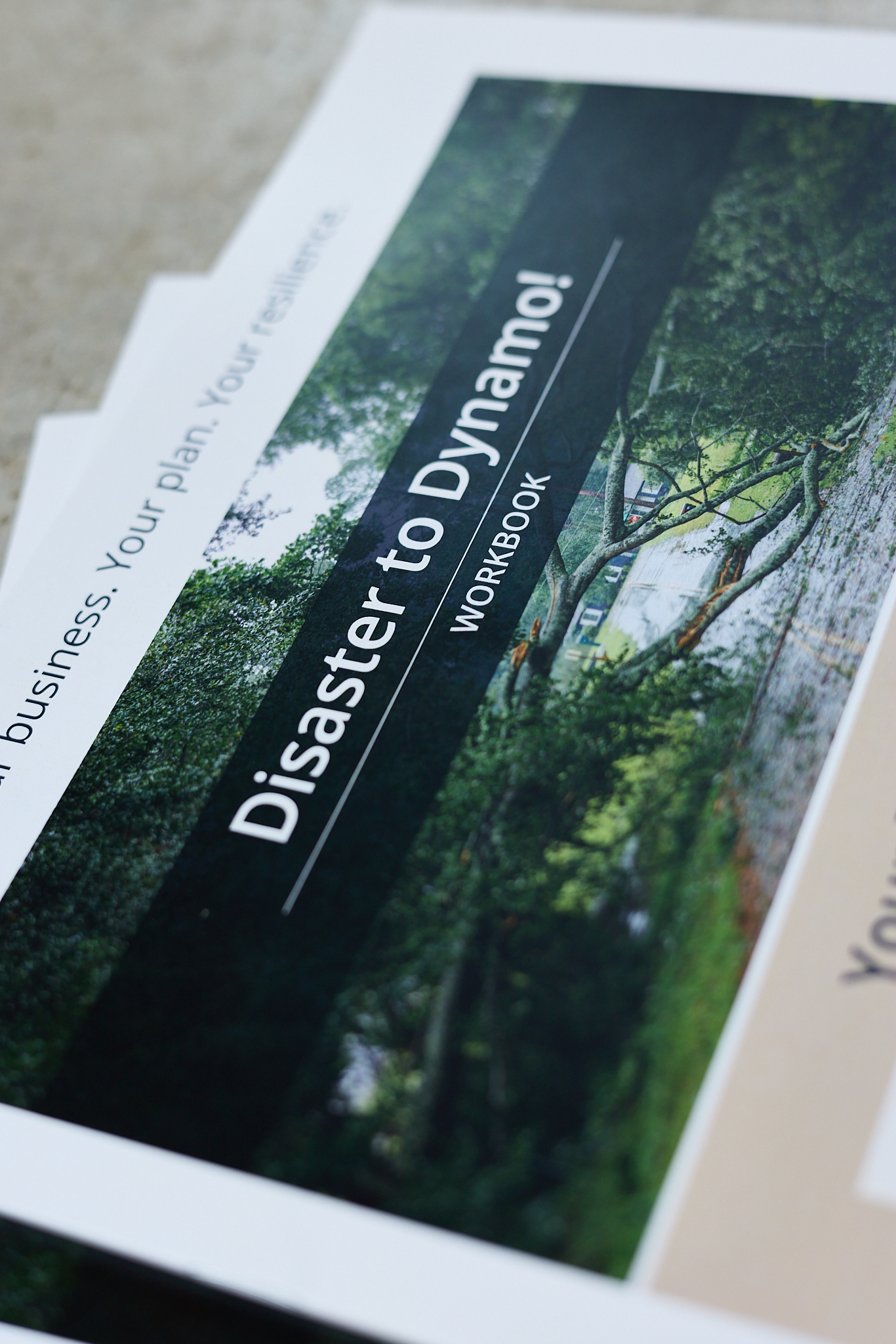
“Rebecca is very detailed,” says Eleanor. “She asks a lot of questions, and she follows up one-on-one with businesses, which builds the resiliency we want in the community.”
Improved Confidence and Clear Plans for Every Stage of Crisis Response
The results of the Disaster to Dynamo workshop point to a shift that is hard to measure, yet integral to the foundations of a resilient business community: confidence and preparedness.
“It’s not something you can measure the success of in a traditional way,” says Eleanor. “You are increasing the preparedness level. The hope is that, God forbid a disaster happens, you will see that businesses are prepared to respond to that disaster.”
Every participant left the workshop with a clear sense of what to do first in a crisis, how to recognize when normal operations shift into crisis mode, and greater confidence communicating with staff, customers, suppliers, and partners during disruptions. The majority also walked away with stronger leadership confidence under pressure.
Eleanor saw participating businesses leave the workshop with several practical outcomes, including refined crisis plans that identified gaps and strengthened responsibilities, as well as first drafts of crisis plans that clearly outlined who should take ownership of which key response activities.
“I love seeing the practical outcomes from these workshops,” says Eleanor. “My hope is that participants will go back and review their processes and systems, and look for ways to put a plan in place.”
For the Town of Canmore, the broader payoff shows up as economic resilience and business continuity benefits for the local economy. Other major benefits include faster recovery after disruptions and reduced strain on municipal emergency response and recovery systems.

Building Resilience Through a Repeatable System
Eleanor plans to make emergency preparedness training an annual practice in Canmore and intends to continue the partnership with RIC.
“Repetition is key,” says Eleanor. “If we can bring it up again and again, sooner or later, other businesses will realize it’s something they need to work on. And my hope is that it’s before we are actually in a crisis situation.”
Eleanor’s broader philosophy and her experience working in other emergencies is the driving force behind the plans she has for the Town of Canmore and the advice she gives to other municipalities.
“Emergency preparedness should not be an afterthought,” she says. “It should be something you think of ahead of time so you can support your community and its longevity. Many communities think about it when something has already happened, and unfortunately that makes recovery even harder.”
Curious to learn more?
Contact RIC Disaster Management to learn more about our disaster and crisis management solution services.
RIC BLOGS

Supporting Disaster Preparedness in Indigenous Communities
Indigenous Peoples are disproportionately affected by disasters like floods and wildfires. As weather patterns shift and annual disaster seasons become the norm, the effects of climate change on Indigenous communities in Canada are becoming more severe. In 2023, over...

Four Common Gaps in Root Cause Analysis Methods in After Action Reports
Each community disaster is a learning opportunity. As disasters become more frequent, leaders need a system to assess what happened and how to improve. This will help strengthen their disaster preparedness plans for the future. Completing an incident analysis and...

When to Hire an Emergency Preparedness Planning Expert
Emergency preparedness planning is essential for communities as the risk of experiencing disaster increases. Events such as wildfires, flooding, and extreme weather are now regular occurrences in communities across Canada. The continued expansion of industrial...

Disability and Disaster Management
In an emergency, no one should ever be left behind. Emergency response plans must be inclusive and provide strategies for supporting every individual in your community—including those with disabilities. When it comes to disability and disaster management, most of the...

Crisis Leadership During a Community Disaster
Effective leadership during a crisis is multifaceted. The crisis leadership style that works for one type of community may not work for another. This is why emergency management teams must tailor crisis leadership training and guidance to the needs of the people...

Four Barriers to Community Disaster Resilience
Long-term community disaster resilience hinges on effective leadership, teamwork, and project management. In the wake of a disaster, individuals across organizations, levels of government, and industry sectors as well as members of the community itself must work...

What is a Disaster Recovery Framework?
A disaster recovery framework outlines your community’s plans for long-term resilience in the wake of an emergency such as a fire, flood, severe weather, or chemical spill. Disasters disrupt many interconnected parts of a community—from infrastructure to essential...
How to Take a Holistic Approach to Your Disaster Recovery Plan
Emergency preparedness and recovery planning create stronger communities that are more resilient to the impacts of disaster. However, to see the benefits of a disaster recovery plan, emergency managers need to take a holistic approach to their risk assessment,...
What it Means to Build a Disaster-Resilient Community
Resilience doesn’t look the same for every community. Those in rural areas have different resources, needs, and cultural values than communities in urban centres. Indigenous communities have important traditional relationships with the land they live on, which also...
Three Critical Oversights in Emergency Planning
Effective response by an emergency management organization (EMO) is dependent on strong relationships. Emergency planning involves a highly complex network of organizations, businesses, teams, and individuals. Successfully planning for emergencies caused by disaster...